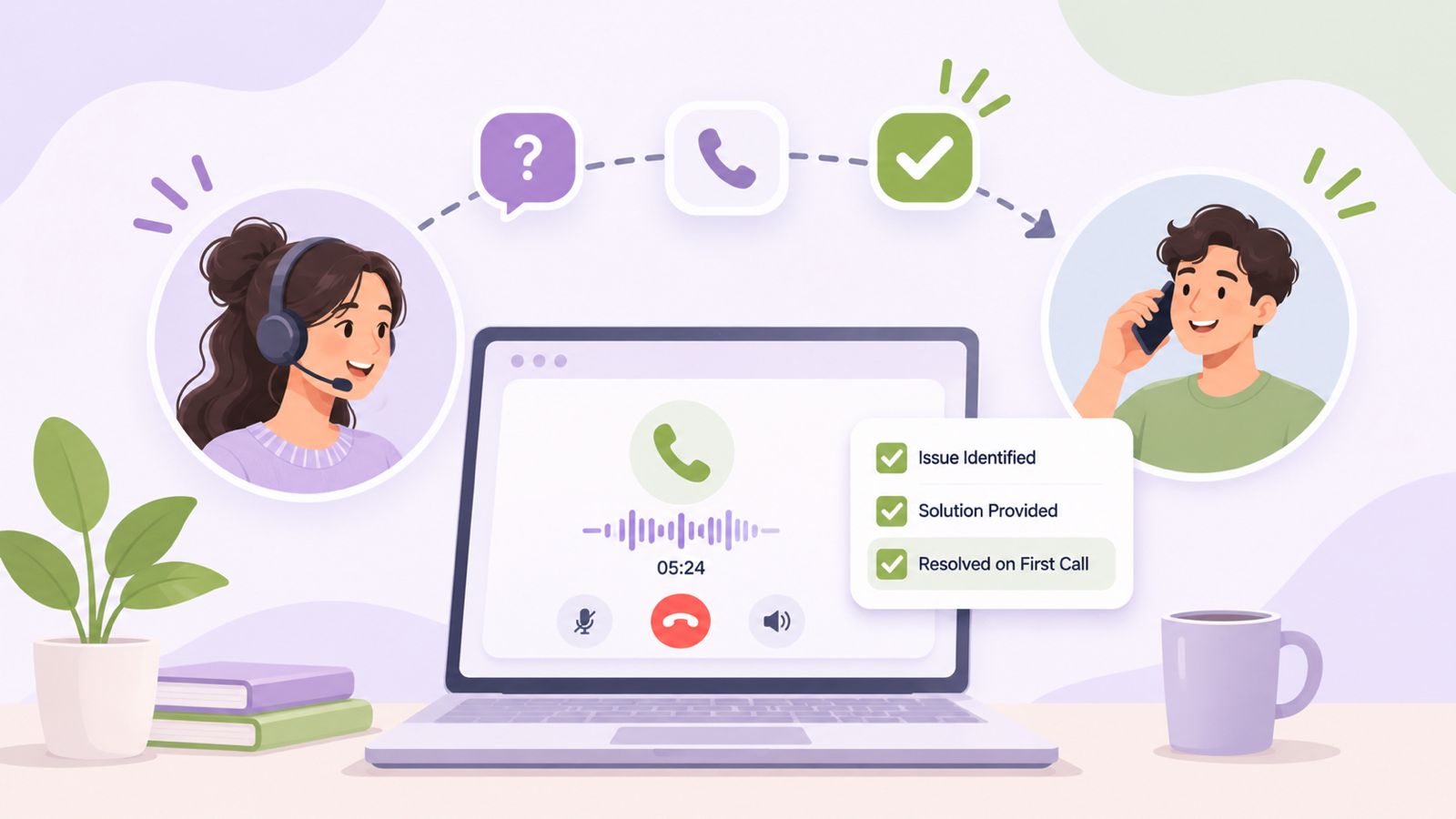
When customers contact a business for support, they expect a quick and complete solution. First Call Resolution (FCR) helps businesses measure how effectively their support teams resolve customer issues during the first phone interaction, without requiring customers to call back about the same problem.
However, many customer support teams still struggle with repeated calls, unnecessary transfers, unresolved complaints, and delayed follow-ups. As a result, customers may have to explain the same problem multiple times.
This is where First Call Resolution becomes important.
A higher FCR rate can indicate more effective problem-solving, better agent training, and more organized customer communication. It can also help businesses reduce avoidable repeat interactions and improve the overall customer experience.
In this guide, we will explain what First Call Resolution means, how to calculate it, what makes a good FCR rate, and how businesses can improve it through practical customer support strategies.
What Is First Call Resolution (FCR)?
First Call Resolution (FCR) is a customer service performance metric that measures the percentage of eligible customer issues successfully resolved during the initial phone interaction, without requiring another call about the same issue.
In other words, it indicates how effectively support agents understand customer problems, access the information they need, and provide appropriate solutions during the first call.
For example, imagine a customer calls a company’s support team because they cannot access their account.
First, the agent verifies the customer’s information.
Next, the agent identifies the reason for the login problem.
Then, the agent guides the customer through the required steps.
Finally, the customer confirms that the issue is resolved.
If the customer does not need to call again about the same issue, the interaction qualifies as a first-call resolution.
However, if the customer has to call again because the original problem remains unresolved, it does not qualify as FCR.
First Call Resolution vs. First Contact Resolution
Although these terms are closely related, they are not always interchangeable.
First Call Resolution: Focuses specifically on resolving customer issues during the initial phone interaction.
First Contact Resolution: Measures whether an issue is resolved during the first interaction across a particular support channel, such as a phone call, email, or live chat.
For example, if a customer contacts a company through live chat and receives a complete solution during that conversation, it may count as First Contact Resolution. However, it would not count as First Call Resolution because no phone call occurred.
The measurement method should clearly define which channels and interactions are included.
Why Is First Call Resolution Important?
First Call Resolution is more than a customer support metric. It also provides insight into how effectively a business manages customer communication and problem-solving.
When customers receive effective assistance during their first interaction, they spend less time waiting, explaining problems, and following up. Consequently, support teams can manage their workload more efficiently.
Here are five important benefits of improving FCR.
1. Improves Customer Satisfaction
Customers generally prefer quick and complete solutions rather than multiple conversations about the same issue.
When support agents resolve problems during the first interaction, customers are more likely to feel that the business understands their needs. As a result, businesses can create a smoother support experience and strengthen customer relationships.
2. Reduces Repeat Calls
Unresolved issues often result in additional calls, which increases the workload for support agents.
By improving FCR, businesses can reduce avoidable repeat interactions. Consequently, agents can dedicate more time to new customer enquiries instead of repeatedly handling the same problems.
3. Improves Agent Productivity
When customers repeatedly contact support about the same issue, agents spend valuable time reviewing previous conversations and understanding what went wrong.
However, an organized support process helps agents access customer history, understand previous actions, and provide more effective assistance. This allows teams to focus on resolving problems rather than collecting the same information repeatedly.
4. Reduces Customer Effort
Customers should not have to repeat their account information or explain the same problem to multiple representatives.
A higher FCR rate can indicate that customers are receiving more consistent support with fewer unnecessary interactions. Therefore, businesses should consider FCR when evaluating the overall customer experience.
5. Helps Identify Operational Problems
A consistently low FCR rate can indicate deeper issues within a customer support operation.
For instance, some common problems include:
- Agents may not have sufficient product knowledge.
- Call routing may connect customers to the wrong department.
- Customer information may be incomplete.
- Internal processes may require unnecessary approvals.
- Support documentation may be outdated.
By monitoring FCR, managers can identify these problems. More importantly, they can improve the processes responsible for unresolved interactions.
How to Calculate First Call Resolution Rate
Businesses can calculate First Call Resolution using a straightforward formula.
First Call Resolution Formula:
FCR Rate = (Number of Issues Resolved During the First Call ÷ Total Eligible Customer Issues) × 100
For example, suppose a customer support team handles 500 eligible customer issues in one month.
Out of these:
- 375 issues are resolved during the first interaction.
- 125 issues require additional contact.
The calculation would be:
FCR = (375 ÷ 500) × 100
FCR = 75%
This means the support team successfully resolved 75% of eligible customer issues during the first interaction. Meanwhile, the remaining 25% required additional contact or were not resolved during the initial interaction.
Another Practical Example
Consider a company that receives customer calls about billing issues.
During one week:
| Metric | Number |
|---|---|
| Eligible customer issues | 200 |
| Issues resolved on first contact | 150 |
| Issues requiring follow-up | 50 |
| First Call Resolution Rate | 75% |
Therefore, the team has an FCR rate of 75%.
However, the company should also investigate why the remaining 50 issues required additional contact. Perhaps agents lack access to billing information, approval processes are too complicated, or customers are being transferred between departments.
As a result, the formula identifies the performance level, while further analysis helps explain the reasons behind it.
Important Considerations When Measuring FCR
For an accurate FCR calculation, businesses should establish consistent measurement rules.
Consider the following points:
- Use unique customer issues: Avoid counting every repeat call about the same problem as a separate issue.
- Define a repeat-contact period: Decide how long after the initial interaction a repeat call will be associated with the original issue.
- Set eligibility criteria: Specify which customer interactions should be included in the calculation.
- Account for transfers: Define whether an issue resolved after an internal transfer during the same interaction qualifies as FCR.
- Validate resolution: Use customer feedback where possible to confirm that the issue was actually resolved.
Different measurement methods can produce different FCR results. Therefore, businesses should document their methodology before comparing performance across teams or periods.
What Is a Good First Call Resolution Rate?
There is no single FCR target that works for every business. The appropriate target depends on several factors, including:
- Industry and service complexity.
- Types of customer enquiries.
- Agent experience and training.
- Available support resources.
- Measurement methodology.
- Whether the business handles simple enquiries or complex technical issues.
According to SQM Group’s published contact center research:
- 71%: Reported industry benchmark average.
- 70%–79%: Considered a good FCR performance range.
- 80% or higher: Considered a world-class FCR rate by SQM Group.
SQM Group also notes that only a small proportion of benchmarked call centers achieve world-class performance.
However, these figures are reference points rather than universal standards. Actual results can vary depending on industry, call complexity, customer expectations, and how FCR is measured.
For example, resolving a basic billing enquiry may require less time and fewer resources than troubleshooting a complex technical issue.
Therefore, businesses should compare their performance with relevant industry benchmarks and their own historical results.
Ultimately, rather than focusing only on a percentage, businesses should also monitor whether customers are actually receiving complete and satisfactory solutions.
10 Ways to Improve First Call Resolution in Your Contact Center
Improving FCR requires more than asking agents to resolve calls faster. Instead, businesses need to improve the entire support process, from the moment a customer calls to the point where the issue is confirmed as resolved.
Here are ten practical strategies businesses can implement.
1. Improve Call Routing and Connect Customers to the Right Agent
One of the common reasons for repeated calls is incorrect call routing.
When customers reach the wrong department, they may need to explain their problems again or wait while the call is transferred. Consequently, this creates unnecessary delays and increases customer effort.
Businesses can improve this process through:
- IVR menus.
- Department-based routing.
- Ring groups.
- Business-hours routing.
- Agent availability rules.
For example, a customer calling about a payment issue should be directed to the billing team instead of a general support representative who cannot access billing information.
By connecting customers to the appropriate department at the beginning of the interaction, businesses can reduce unnecessary transfers. As a result, they can improve the chances of resolving the issue during the first call.
2. Provide Agents With Complete Customer Information
Support agents need context to understand customer problems.
If agents cannot access previous conversations, customer details, or relevant account information, they may spend a significant portion of the call collecting information that the business already has.
Therefore, businesses should maintain organized customer records containing:
- Customer contact details.
- Previous call history.
- Open support issues.
- Relevant account information.
- Previous resolutions.
- Pending follow-up actions.
CRM integrations can help bring customer information and communication history into a more organized workflow.
As a result, agents can spend more time solving problems instead of searching for information.
3. Invest in Continuous Agent Training
An agent may understand the communication process but still struggle to resolve specific customer issues.
This often happens when agents lack product knowledge, technical understanding, or the authority to make decisions.
To address this, regular training should cover:
- Product and service knowledge.
- Common customer complaints.
- Troubleshooting procedures.
- Communication skills.
- Handling difficult conversations.
- Escalation procedures.
Additionally, managers can review recorded calls and use real customer scenarios during training sessions.
The goal is to help agents understand problems independently and provide accurate solutions without unnecessary transfers. Over time, this can improve both resolution quality and customer confidence.
4. Build an Updated Knowledge Base
A knowledge base gives support agents access to important information while handling customer enquiries.
For example, it can include:
- Frequently asked questions.
- Troubleshooting instructions.
- Product documentation.
- Billing procedures.
- Account management steps.
- Common error explanations.
If multiple customers contact support about the same login problem, agents should be able to access a documented troubleshooting process rather than searching for a solution during every call.
Moreover, businesses should regularly update their knowledge base whenever products, policies, or internal processes change. This ensures agents can rely on accurate information while resolving customer issues.
5. Reduce Unnecessary Call Transfers
Call transfers are sometimes necessary, especially when an issue requires specialized knowledge.
However, repeated transfers can create a frustrating customer experience and increase the time needed to resolve an issue.
Before transferring a call, agents should:
- Understand the reason for the transfer.
- Confirm which department can resolve the issue.
- Share relevant customer information with the receiving agent.
- Explain the next steps to the customer.
- Avoid asking customers to repeat information unnecessarily.
Whenever possible, businesses should use structured routing processes to connect customers with the appropriate team from the beginning. This can reduce repeated explanations and make support interactions more efficient.
6. Use Call Recording and Quality Assurance
Call recordings allow managers to understand how customer interactions are handled in practice.
By reviewing recordings, businesses can identify:
- Repeated customer complaints.
- Incomplete explanations.
- Incorrect information.
- Unnecessary transfers.
- Communication gaps.
- Missed opportunities to resolve problems.
For example, if customers frequently call back after receiving unclear billing explanations, managers can review relevant calls and improve agent training or documentation.
Therefore, call quality reviews should focus on resolution quality, not just conversation length. In addition, regular reviews can help managers identify recurring issues and provide more targeted coaching.
7. Analyze Call Data and Identify Repeat-Call Patterns
Call analytics can help managers understand why customers contact support repeatedly.
Instead of reviewing only the total number of calls, businesses should examine patterns across different types of enquiries.
For instance, useful data points include:
- Call volume.
- Missed calls.
- Call duration.
- Call outcomes.
- Repeat interactions.
- Agent performance.
- Common enquiry categories.
If repeat calls increase significantly after a product update, this could indicate a technical issue or a gap in customer communication.
By identifying these patterns, businesses can address the underlying problem instead of treating every repeat call as an individual incident. Consequently, support teams can make improvements based on actual customer interaction data.
8. Give Agents the Authority to Resolve Common Issues
Sometimes, agents know exactly what a customer needs but cannot complete the required action without supervisor approval.
As a result, routine issues can create unnecessary delays and additional interactions.
To prevent this, businesses should establish clear decision-making guidelines that allow trained agents to handle routine issues within approved limits.
Examples include:
- Updating basic account information.
- Correcting eligible billing errors.
- Explaining standard policies.
- Processing authorized requests.
- Resolving common technical issues.
Of course, sensitive, high-value, or complex cases should still follow appropriate approval and escalation procedures.
The objective is to remove avoidable delays without compromising business policies or customer security.
9. Establish Clear Escalation Procedures
Not every customer problem can be resolved by the first agent.
Some issues require technical specialists, supervisors, or other departments. Nevertheless, a structured escalation process helps ensure that complex cases reach the right person without creating confusion.
An effective escalation process should define:
- Which issues require escalation.
- Which team is responsible for each issue.
- What information must be shared.
- Who owns the customer interaction.
- How the customer will receive updates.
Even when an issue cannot be resolved immediately, clear ownership and communication can prevent customers from repeatedly chasing the business for updates.
Therefore, escalation should be treated as a managed process rather than simply transferring responsibility to another team.
10. Collect Customer Feedback After Support Interactions
An agent marking a call as resolved does not always mean the customer considers the issue resolved.
That is why customer feedback should be part of FCR measurement.
For example, businesses can use short post-interaction surveys, such as:
- Was your issue resolved during this interaction?
- Did you receive the information you needed?
- Was the solution clear?
- Would you need to contact support again about this issue?
Customer feedback helps validate internal resolution records and identify cases where agents may have closed an issue prematurely.
Additionally, it provides insight into the overall support experience. By combining customer feedback with call data, managers can make more informed decisions about service improvements.
Common Reasons Why First Call Resolution Rates Are Low
Before implementing improvement strategies, businesses should understand why their existing FCR performance may be weak.
| Common Problem | How It Affects FCR | Recommended Action |
|---|---|---|
| Incorrect call routing | Customers reach the wrong department. | Improve IVR and routing rules. |
| Incomplete customer information | Agents lack the context needed to resolve issues. | Improve CRM data access and integration. |
| Insufficient agent training | Agents struggle with common customer problems. | Provide regular product and process training. |
| Outdated documentation | Agents cannot find accurate solutions. | Maintain an updated knowledge base. |
| Unnecessary approvals | Routine issues take longer to resolve. | Define agent decision-making authority. |
| Poor call documentation | Previous interactions are difficult to understand. | Standardize call notes and outcomes. |
| Weak escalation processes | Customers experience repeated transfers. | Define escalation ownership and procedures. |
| Inadequate feedback collection | Businesses cannot validate resolution quality. | Introduce customer feedback surveys. |
By understanding these causes, businesses can prioritize improvements based on actual operational problems. More importantly, they can focus on fixing the root causes instead of simply trying to increase the FCR percentage.
Key Metrics to Track Alongside First Call Resolution
FCR should not be evaluated in isolation.
A support team may achieve a high FCR rate while customers still experience long waiting times, poor communication, or unsatisfactory service.
Therefore, combining FCR with other customer support metrics provides a more complete picture of operational performance.
| Metric | What It Measures | Why It Matters |
|---|---|---|
| First Call Resolution | Issues resolved during the first phone interaction. | Measures resolution effectiveness. |
| Average Handle Time (AHT) | Average time spent handling an interaction, including talk time, hold time, and after-call work. | Helps evaluate support workload and efficiency. |
| Customer Satisfaction (CSAT) | Customer satisfaction with a support interaction. | Shows how customers perceive the experience. |
| Average Speed of Answer (ASA) | Average time customers wait before an agent answers. | Helps evaluate accessibility. |
| Call Abandonment Rate | Percentage of eligible callers who disconnect before reaching an agent. | Identifies potential waiting-time problems. |
| Repeat Contact Rate | Percentage of customers who contact support again about an issue within a defined period. | Helps identify unresolved problems. |
| Service Level | Percentage of eligible calls answered within a specified time target. | Measures responsiveness. |
For example, a support team may improve its FCR rate while Average Handle Time increases slightly because agents are spending more time understanding and resolving issues properly.
That is not necessarily a problem. Instead, the objective should be to provide complete, accurate solutions while maintaining an efficient and sustainable support operation.
In other words, businesses should balance resolution quality, customer satisfaction, and operational efficiency rather than optimizing a single metric.
How Call Analytics and Communication Tools Help Improve FCR
Improving First Call Resolution requires visibility into customer interactions and the processes surrounding them.
Communication tools can help businesses organize these interactions, understand call outcomes, and identify areas that need improvement.
Some important capabilities include:
Intelligent Call Routing: Directs incoming calls to appropriate departments or available agents, reducing unnecessary transfers.
Call Recording: Allows managers to review conversations, identify communication gaps, and support agent training.
Call Tags and Notes: Help categorize customer interactions and maintain useful records of call outcomes.
CRM Integration: Keeps customer information and previous interaction history accessible to support teams.
Call Analytics: Helps managers monitor calling activity, identify patterns, and evaluate team performance.
SMS Follow-Ups: Allow businesses to share relevant information and communicate next steps after a call when appropriate.
Together, these capabilities create a more organized support workflow. Furthermore, they give managers better visibility into how customer interactions are handled and where improvements may be needed.
How DialNext Helps Support Teams Improve First Call Resolution
First Call Resolution depends on more than the performance of individual support agents. It also depends on how effectively a business manages incoming calls, customer information, and communication history.
DialNext provides a cloud-based business communication platform that helps customer support teams organize these workflows.
With DialNext, businesses can use several communication capabilities:
Intelligent Call Routing and IVR
Direct customers to the appropriate department through configurable IVR menus, ring groups, and business-hours routing. As a result, businesses can organize incoming calls and reduce avoidable transfers.
Call Recording and Playback
Review customer conversations for quality assurance, agent coaching, and a better understanding of unresolved issues. In addition, recordings can help managers identify recurring communication gaps.
Call Tags and Notes
Categorize call outcomes and maintain useful information about customer interactions. This helps teams keep customer communication records more organized.
CRM Integrations
Connect calling workflows with supported CRM platforms to keep customer information and communication records organized. Consequently, agents can access relevant context while handling customer interactions.
Call Analytics
Monitor call volume, handle times, and available call activity data to identify operational patterns. Moreover, these insights can help managers understand trends that may affect support efficiency.
SMS Support
Continue customer conversations through text messaging when sharing information or following up is more appropriate than another phone call.
Together, these capabilities can help businesses improve call management, maintain better customer context, and create more consistent support workflows.
However, technology alone cannot guarantee a higher FCR rate. Businesses must also invest in agent training, accurate documentation, clear escalation procedures, and reliable resolution processes.
To learn more about how DialNext supports customer communication operations, explore the DialNext Customer Support platform.
Frequently Asked Questions (FAQs)
1. What does First Call Resolution (FCR) mean?
First Call Resolution (FCR) refers to the percentage of eligible customer issues successfully resolved during the first phone interaction without requiring another call about the same problem.
2. How is First Call Resolution calculated?
FCR is calculated by dividing the number of eligible customer issues resolved during the first call by the total number of eligible customer issues, then multiplying the result by 100.
Formula: FCR = (First-call resolutions ÷ Total eligible issues) × 100.
3. What is a good First Call Resolution rate?
According to SQM Group, 70%–79% is considered a good FCR performance range, while 80% or higher is considered world-class. However, the appropriate target depends on the industry, issue complexity, and measurement methodology.
4. Why is First Call Resolution important for customer support teams?
FCR helps businesses evaluate how effectively their support teams resolve customer problems. By improving it, businesses can reduce repeat interactions, improve customer experience, and make support operations more efficient.
5. What causes a low First Call Resolution rate?
Common causes include incorrect call routing, insufficient agent training, incomplete customer information, outdated documentation, unnecessary transfers, and unclear escalation procedures.
6. How can businesses improve First Call Resolution?
Businesses can improve FCR by training agents, improving call routing, providing access to customer history, maintaining knowledge bases, reviewing call recordings, and collecting customer feedback. Additionally, they should regularly analyze repeat-contact patterns to identify unresolved issues.
7. What is the difference between First Call Resolution and First Contact Resolution?
First Call Resolution focuses on issues resolved during the initial phone interaction. In contrast, First Contact Resolution measures resolution during the initial interaction across a specified support channel, such as calls, email, or live chat.
8. Does increasing First Call Resolution reduce Average Handle Time?
Not necessarily. Resolving an issue completely may require a slightly longer initial interaction. However, it can reduce the total time spent across multiple interactions about the same problem.
9. How do CRM integrations help improve FCR?
CRM integrations help agents access customer details, previous interactions, and relevant records. Consequently, this reduces the need to collect the same information repeatedly and helps agents understand the context of customer enquiries.
10. Can call analytics improve First Call Resolution?
Yes. Call analytics can help businesses identify repeat-call patterns, monitor call outcomes, evaluate team performance, and understand where support workflows need improvement. As a result, managers can make more informed decisions about operational changes.
Conclusion
First Call Resolution is an important indicator of how effectively a business handles customer support interactions.
When customers receive complete solutions during their first interaction, they spend less time following up, agents can focus on other enquiries, and businesses can create more consistent support experiences.
However, improving FCR requires more than setting performance targets. It involves better call routing, continuous agent training, accurate customer information, effective escalation processes, and regular performance monitoring.
By combining these practices with the right communication technology, businesses can build support operations that focus on resolving customer problems rather than simply handling more calls.
Ultimately, successful customer support is not about how quickly a call ends. Instead, it is about whether the customer’s problem is actually solved.
References and Further Reading
- SQM Group – First Call Resolution Benchmark: Measure, Benchmark, and Improve
- SQM Group – What Is a Good First Call Resolution Rate?
- SQM Group – First Call Resolution Operating Strategies
- ICMI – First Call Resolution Resources
Improve Your Customer Support Workflows with DialNext
Want to reduce unnecessary transfers, organize customer conversations, and make your support operations more efficient?
DialNext brings business calling, call routing, CRM connectivity, call recordings, and messaging capabilities together to help teams manage customer interactions more effectively.
Give your support team the tools to create more organized and consistent customer conversations.
Ready to improve the way your business handles customer calls? Explore DialNext and discover how better communication workflows can support your team.